Luca Bolzonello, Matteo Bruschi, Edoardo Amarotti, Zachary Faitz, Julian Lüttig, Joseph Wragg, Stefan Müller, Xiaoji Xu, Andreas Jakobsson, Pavel Malý, Barbara Fresch, Elisabetta Collini, Donatas Zigmantas, Tönu Pullerits, Tobias Brixner, Jennifer P. Ogilvie, Martin Zanni and Niek F. van Hulst
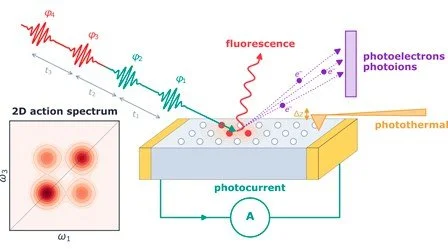
Action-detected two-dimensional electronic spectroscopy (A-2DES) has emerged as a powerful alternative to coherent 2DES, offering unique advantages, including freedom from geometrical constraints imposed by directional phase-matching requirements, lower demands on sample quality, operando capability, and seamless integration with microscopy. By measuring incoherent observables, such as fluorescence, photocurrent, photoelectrons, or photoions from excited-state populations, action detection enables studies of systems that might be difficult to access using traditional coherent methods. However, this approach introduces fundamental challenges, including incoherent mixing, additional Liouville pathways, and detection nonlinearities that require careful consideration. This article provides the theoretical foundations, experimental implementations, key advantages, and critical limitations of action-detected spectroscopy, providing guidance for optimal application of this rapidly evolving technique across diverse systems ranging from single molecules to working photovoltaic devices.