Yogita Silori, Yongxi Li, Aswathy Jayachandran, Barry D. Dunietz, Stephen R. Forrest, and Jennifer P. Ogilvie
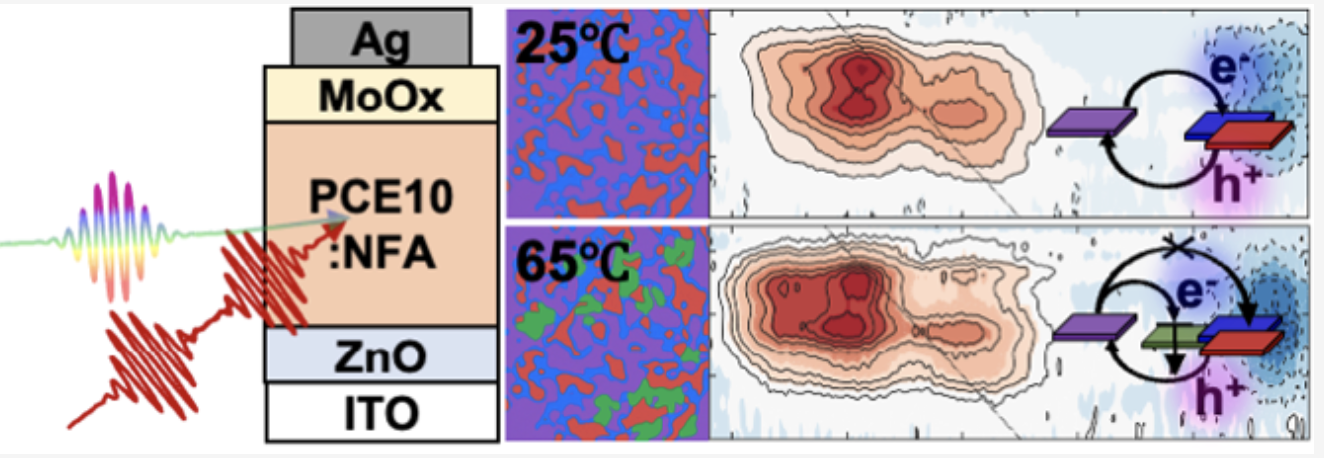
ABSTRACT: Ternary organic photovoltaic devices incorporating A-D-A type non- fullerene acceptors offer promising enhancements in power conversion efficiency. However, fabrication conditions can introduce impurities that disrupt molecular packing and the charge-transfer (CT) dynamics, thereby reducing performance and stability. This study investigates ultrafast CT dynamics in ternary organic photovoltaics prepared at room temperature (25°C,″cold″) and elevated temperature (65°C,″hot″) using two-dimensional electronic spectroscopy in combination with computational spectral analysis to elucidate the underlying photophysical processes. While the cold ternary blend preserves chemical purity, enabling efficient CT, the hot blend exhibits a higher level of impurities, resulting in population trapping in intramolecular CT-type/dark states. This impurity-induced trapping promotes nonradiative recombination and suppresses electron transfer pathways. These findings underscore the critical role of controlled fabrication in mitigating energy losses and optimizing ternary organic photovoltaic performance and reliability.